
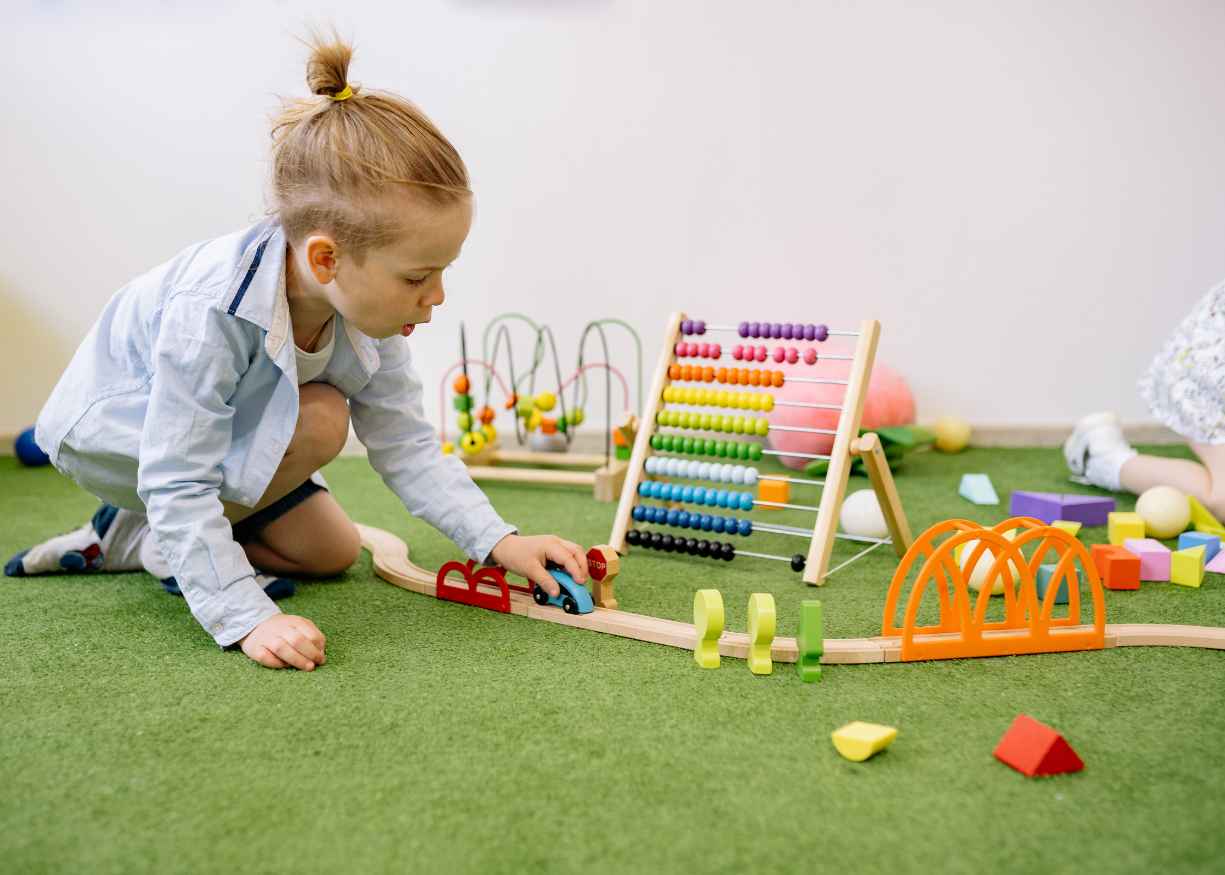
Families often arrive at our doors with a bag of expensive toys and a quiet worry that they are not doing enough. It is a common feeling, and it is almost always misplaced. Babies and toddlers do not learn from screens, flashcards or age-graded gadgetry. They learn from repetition, movement, and back-and-forth with a person who is paying attention — and the materials that support that are already in your kitchen.
Why simple is better
A toy that lights up and makes a noise when a button is pressed does the playing; the child just watches. A pot, a wooden spoon and a pile of bowls do the opposite: the child decides what happens next, which is exactly the kind of thinking that builds concentration, problem-solving and language. This is the same reasoning behind our Reggio-inspired approach, where educators offer open materials — fabric, shells, cardboard, water, clay — and let children lead.
Treasure baskets
A treasure basket (sometimes called a heuristic basket) is a shallow container filled with safe, everyday objects of different textures and weights. Raising Children Network's treasure basket play ideas describe the same idea: fill a lidded container with things you already own, and let the baby choose what to investigate. Keep it simple and refresh it occasionally so there is something new to discover.
- Wooden spoon, metal measuring cup, silicone spatula, large wooden peg
- Ribbon, a silk scarf, a brush with soft bristles, a coarse sponge
- Pine cone, smooth stone, shell, cardboard tube, cork
- A ball of wool, a small tin of bells, a folded towel
Sit close, stay quiet for a minute, and only describe what your baby is doing rather than directing it. Everything goes in the mouth at this stage, so keep items too large to swallow, check them before each session, and stay within arm's reach.
Play that costs nothing
- Posting: drop pegs, buttons or folded paper into a tin with a slot, then tip it out and do it again. Repetition is the point.
- Stacking and knocking down: blocks, cups or tins. Being able to destroy what you built is a genuine lesson in cause and effect.
- Water play: a basin, two sponges, a jug and a funnel. Squeezing a sponge is one of the best hand exercises there is.
- A cardboard box big enough to climb into, plus a blanket to make it a cave.
- Kitchen help: washing vegetables, tearing lettuce, stirring batter, pouring from a small jug.
- A washing-line to peg wet hand towels over — surprisingly good for small fingers.
Language grows out of play, not drills
You do not need to teach words; you need to narrate. Name what your child is holding, describe what they are doing, and pause so they have room to fill the gap. Singing the same three songs every day is not a failure of imagination — repetition is how young children learn that words carry meaning. If you would like a sense of what is typical at each age, Speech Pathology Australia's Communication Milestones Kit sets out what most children are doing at each stage, and healthdirect's guide to speech development is a plain-language summary of the same milestones.
Follow your child's lead. When they look at you, point, or hand you something, that is an invitation — the conversation matters more than the toy.
A sample hour at home
You do not need a schedule, but a loose shape helps. Fifteen minutes of floor play with the treasure basket while you sit nearby and describe what you see. Ten minutes of helping in the kitchen — washing a carrot, tearing lettuce for a salad. A walk where you stop often and name things: a dog, a big truck, wet leaves, a puddle. Then a bath with cups and a funnel, and the same song before bed. That is a genuinely rich day for a one-year-old, and it uses nothing you need to buy.
Where to go for more ideas
Raising Children Network's homemade toys and free activities covers the same ground by age, and Playgroup Victoria runs free and low-cost playgroups across the state where children play and parents meet each other. Both are useful if your child is at home with you a few days a week and you want somewhere to go.
When to ask for advice
Trust your instincts. If your child is not using gestures like pointing or waving by around twelve months, is not yet using single words by eighteen months, or if you have any niggling worry about hearing, speech or how they play with other children, mention it early — to your child health nurse, your GP, or the educators who see your child each day. Early advice is nearly always reassuring, and if something is going on, support works best when it starts young. At Lumora we can help you think through next steps and connect you with the right service, and you are welcome to book a tour and see how this kind of play runs through our babies and toddlers rooms.